
Nobody decides to stay up until 2:30 AM. It happens one late night at a time, and it happens because of how your body clock is actually built, not because you lack discipline.
Quick answer
The human circadian clock runs about 24.2 hours on average, slightly longer than the actual day ( Crowley & Eastman, Journal of Sleep Research, 2018). Without a daily light reset, that extra fraction of an hour compounds night after night, pushing bedtime later. Evening screen light adds to the drift on top of that. Fixing it takes consistent timing, held in small steps, not a single hard reset.
Why does your sleep schedule keep getting later?
In 2018, sleep researchers measured the human circadian pacemaker under controlled conditions with no light or clock cues and found it runs on an average period of about 24.2 hours, not exactly 24 (Crowley & Eastman, Journal of Sleep Research, PMC, 2018). That extra roughly 12 minutes a day does not sound like much, but it only points one direction: later. Left alone, without a daily reset from morning light, the body's internal clock keeps sliding past the actual clock on the wall.
That is the actual mechanism behind a pattern a lot of people recognize but describe as a personal failure. As Shifti's founder put it, describing his own schedule: "It doesn't break in one night. One late deadline, one more episode, one endless scroll — and the baseline quietly slides. A month later, 2:30 doesn't even feel late anymore." He has also described how far that drift went before he did anything about it: "It crept past 3 AM. Five alarms and a lot of coffee didn't fix my mornings — they just made the guilt louder, and the guilt pushed bedtime even later."
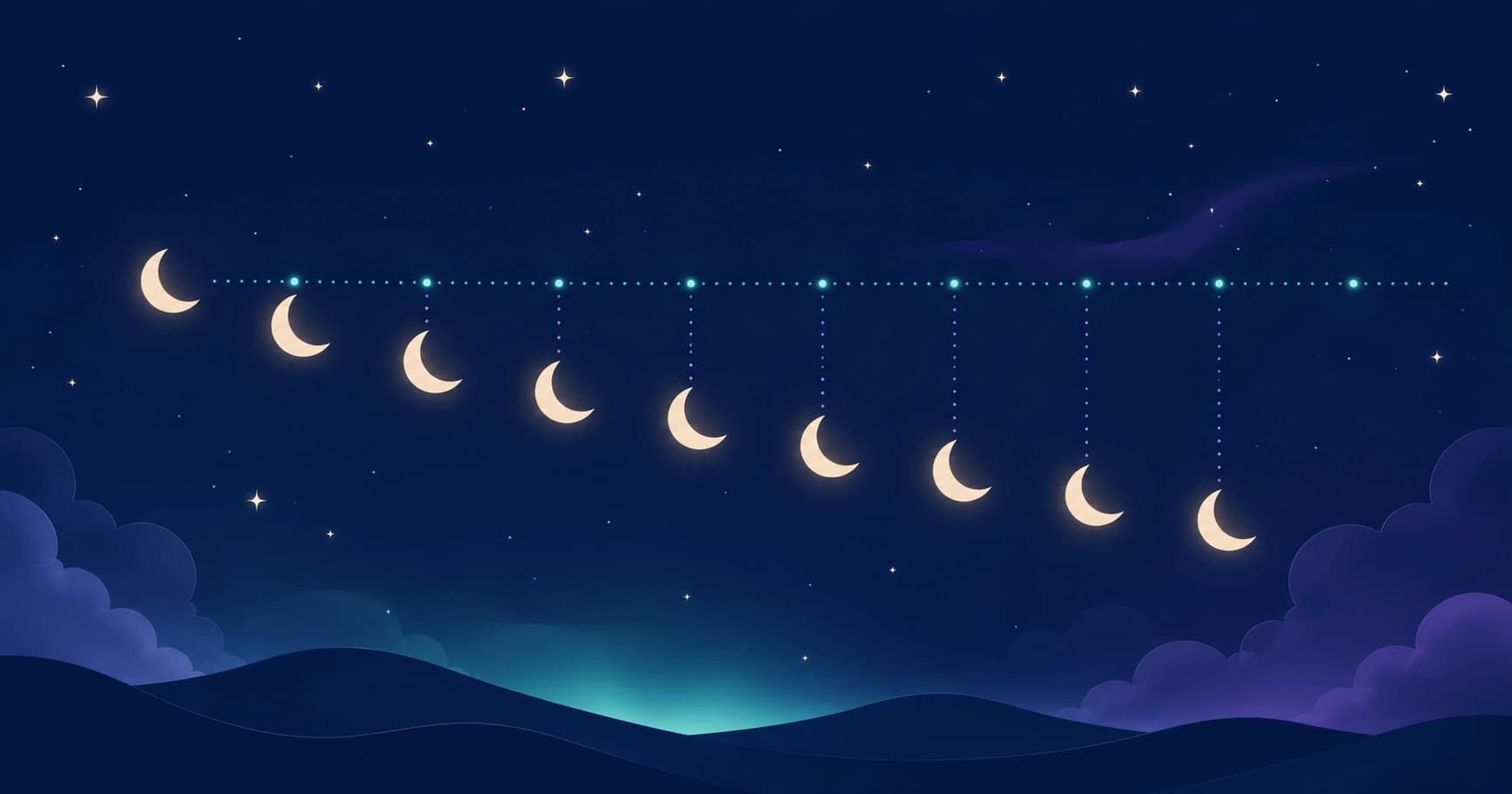
Drift without a daily reset
Illustrative diagram, not raw study data. Conceptual pattern based on the ~24.2-hour free-running period reported in Crowley & Eastman, Journal of Sleep Research, 2018.
Is it normal for a sleep schedule to drift, or is something wrong?
Drift is common enough to have a name: social jetlag, the mismatch between the sleep schedule you keep on workdays and the one you keep on weekends. In a 2024 analysis of NHANES survey data, roughly 31% of U.S. adults aged 20-39 showed social jetlag of two hours or more (Journal of Nutritional Science, PMC, 2024). A separate 2025 study of nearly 20,000 children and adolescents in England found an average social jetlag of 1.88 hours, peaking around age 15 (Chronobiology International, PMC, 2025).
So a drifting schedule is not a rare personal failure. It is what the clock does by default, and the weekend "catch-up" sleep that feels like relief is often the thing quietly reinforcing the delay week after week.
Why is it so much easier to stay up late than to wake up early?
Because the body's natural period runs longer than 24 hours, staying up later works with the clock's default bias. Trying to sleep earlier works against it. That asymmetry is why "just go to bed earlier tonight" so often fails: it asks the clock to move in the one direction it does not want to move on its own, in a single jump.
For a full walkthrough of a method built around that asymmetry instead of fighting it, see the full 15-minute method.
Does screen time before bed actually delay your body clock?
Yes, on top of the clock's natural drift. In a controlled PNAS study, participants who read on a light-emitting e-reader in the evening had dim-light melatonin onset, the natural rise of the hormone that signals the body it's time to wind down, delayed by more than 1.5 hours compared with reading a printed book (22:31 versus 21:01) (Chang et al., PNAS, 2015). Melatonin here is simply the body's own hormone, produced earlier or later depending on light exposure, not something the study had participants take.
The same participants also took longer to fall asleep after the e-reader condition, about 25.7 minutes versus 15.8 minutes with a printed book, and reported less alertness the next morning. The mechanism is light-sensitive cells in the eye that signal the brain to hold off on melatonin when they detect blue-enriched light in the evening, the same signal daylight sends earlier in the day.
What actually re-anchors a drifting sleep schedule?
Consistent daily timing, not willpower and not a single hard reset. Since the clock's own bias always points later, a large overnight correction is fighting that bias in one big jump, which is why it tends to collapse within a few days. A schedule held in place with small, repeated steps works with the same 24.2-hour bias instead of against it, one step at a time.
That same failure pattern shows up after travel, too. See how travel resets this same drift for what a realistic recovery timeline looks like, and a realistic timeline for shifting back for how long the full correction tends to take. If you've already pulled an all-nighter, see what to do if you've already pulled an all-nighter for the recovery plan.
How Shifti keeps a schedule from drifting back
Shifti is built directly around this mechanism: instead of one hard reset, it moves your target bedtime 15 minutes earlier at a time and holds each step until it feels normal before moving again, the same approach described in how the staircase method holds a schedule in place. It's the method its founder built for himself first — see why Sam built Shifti after his own drift.
Want help holding the new schedule?
Shifti is free on Android. It paces the 15-minute shifts for you and keeps the plan from sliding back.
FAQ
Why does my bedtime keep creeping later even though I want to sleep earlier?
Because the body's internal clock runs slightly longer than 24 hours, about 24.2 hours on average. Without a daily reset cue like morning light, drift toward a later schedule is the default direction, not a sign of poor discipline (Crowley & Eastman, Journal of Sleep Research, 2018).
Is a drifting sleep schedule a sign of a sleep disorder?
Not necessarily. Social jetlag, the mismatch between weekday and weekend sleep timing, is common: an NHANES analysis found about 31% of young U.S. adults show it. If it's severe, or paired with symptoms like loud snoring or gasping, talk to a doctor.
Why is it so much harder to sleep earlier than to stay up later?
The clock's natural period is longer than 24 hours, so staying up later works with that bias while trying to sleep earlier works against it. That's why 'just go to bed earlier tonight' rarely holds on its own.
Does phone or e-reader use before bed really delay sleep?
Yes. A controlled PNAS study found melatonin onset was delayed by more than 1.5 hours after evening use of a light-emitting e-reader compared with a printed book, and it took longer to fall asleep (Chang et al., 2015).
What actually stops a sleep schedule from drifting back?
Consistent daily timing anchors the clock. Gradual shifts held in place tend to succeed where one large overnight reset tends to fail, because they work with the clock's natural bias instead of fighting it in one big jump.
Sources
- Crowley & Eastman, Free-running circadian period in adolescents and adults, Journal of Sleep Research, PMC (2018)
- Social jetlag and sleep habits in children and adolescents, Chronobiology International, PMC (2025)
- Social jetlag and diet quality among US young adults, PMC (2024)
- Chang et al., Evening use of light-emitting eReaders negatively affects sleep, circadian timing, and next-morning alertness, PNAS (2015)